Showing posts with label plotting. Show all posts

Wednesday, February 8, 2023

Planning, Plotting, Pantsing: What matters? What doesn't?

 A quick look back while Ruthy's kitchen is torn apart and her mystery is due in three weeks!

Words as true today as they were three years back! 

by Multi-published, Award-winning author Ruth Logan Herne

You're a planner.

You're a plotter.

You're a pantser.

Guess what?

It doesn't matter. Not all that much. Not nearly as much as some would have you believe.


How you write isn't nearly as important as how you spend your time. If you're spending all of your time planning or plotting or researching and not writing, well... then your production may drop. Or be non-existent.

What does that mean, you ask?

Simple. We follow the math. Some creative types hate to look at numbers. It stifles their creativity.

(YAWN....)

Like so many things, it comes down to numbers and a writer is actually running a small business. You need to know and understand the numbers of your business to make it work, right? We'll keep it simple, I never get complicated if I can possibly avoid it.

If you plan or plot your book for a month... then write it for two months and have a full book 90 days in:

GO YOU! BONUS!!! YOU ROCKED IT!!!! :)

And I mean that most seriously.

If you didn't plan or overly plot and you still have a book done at 90 days, YOU ROCKED IT, TOO!!! PARTY BONUS FOR YOU AS WELL!

So you're equal, correct? Both with a book done at 90 days, equating the possibility of 4 books/year if they're 70,000 to 80,000 word books. Leaving some editing time there.

You two can go grab coffee now. I'm not talking to youse at the moment. I'm talking to them.

You know who you are...

You've over-plotted four books and haven't finished one.

You've written three great openings, and sent them out to editors and EVEN GOT A BITE ON ONE, a request for a full manuscript, but alas... you haven't finished a manuscript.

And therein lies the problem.

It's not the writing for some folks.

It's the finishing.

When someone does the dishes and leaves them on the counter to air dry: UNFINISHED TASK.

When someone walks out of a bedroom leaving the bed unmade: UNFINISHED TASK

When someone adds pool chemicals but doesn't vacuum the weird things on the bottom: UNFINISHED TASK

When someone washes a car, but doesn't wash the inside of the windows: UNFINISHED TASK

Do you get what's similar about all of these tasks? They look good on the surface. Effort has been expended. Stuff's gotten started, but nothing is finished.

That's a common conundrum, and the basic reason why many authors never get published...

Because writing the whole book isn't easy. It's not the fun part. It's a challenge on a daily basis.

Now I love what I do. Like that cute GMC truck commercial, and the wife that claims the big gray truck, exclaiming "I LOVE IT!!!" And the crazy cute guys acquiesces and nods toward the big red SUV. "I like red."

That's me and writing. I love it.

So maybe I'm jaded because I love what I do, but if you also love it, then why aren't you finishing things?

Here's a probable cause: Your conflict isn't strong enough and your characters are under-developed.

That's another common cause of the malady they call "Writer's Block"... when the brain just can't wrap its head around the story, it's usually because the story is too weak to write. Once you've added layers of conflict, reasons to avoid one another, and big bumps in the road, the kind that are organic to the story, not just thrown in for the author's page count, you have the depth to keep writing. Otherwise it's very hard to know what on earth these characters should do next?

(THAT WAS A VERY LONG, BAD SENTENCE. DON'T DO THAT, OKAY?)

We are all guilty of this at one time or another. And the world didn't end. We re-write.

We deepen the conflict, we add reasons why the characters can't ever get along (Mother/daughter, sister/sister, hero/heroine) and then we have them creep toward the middle...

Not like Justin Timberlake in "Can't Stop the Feeling"... 

And by the way, Justin can creep up on me anytime. The guy is two thumbs up stinkin' adorable, but I digress...

And along those lines, as an author I would be REMISS to not remind you about my newest Love Inspireds "A Cowboy in Shepherd's Crossing", a great story about a cowboy who thinks he know just who he is, what he's doing and where he's going...


Until he finds out he's been living a lie for thirty years.

Great story. Heart-grabbing characters. And a beautiful Western Idaho setting that makes you want to move there, like right now.

I've got a copy to give away to one lucky commenter. It could be you... and I promise: It's a really good story.

What's your plan for this brand new year with no mistakes in it yet? Well, hardly any!

Let me know below and I've got the Keurig set up, delightful creamers and raw sugar. You know you love raw sugar.

I just love saying it!

Raw sugar.

What's the plan, Stan? Answer and I'll tuck your name into the cowboy hat for this latest Shepherd's Crossing book... and a favorite of readers nationwide already!


Multi-published, award-winning inspirational author Ruth Logan Herne is living the dream of writing books that touch the heart-- and soul-- and leave the reader wanting more. Book #50 will be published in 2019 and she is over-the-moon about that! Find her on facebook or Twitter as Ruth Logan Herne, stop by her website ruthloganherne.com and email her at loganherne.com to sign up for her newsletter or just to chat. She's a people person most days, as long as caffeine and chocolate are involved!

Monday, February 8, 2021

Writing is my Boyfriend with Guest Angela Ruth Strong

Erica here: I'm delighted to host Angela Ruth Strong here at Seekerville today. If you know Angela at all, you know that Strong is more than just her name. It's who she is! She's a great friend, a great writer, and so very, very strong. A few weeks ago, she mentioned filling out scene cards in a post on Facebook, and I was intrigued! I'm always curious as to fellow-authors' methods and means of crafting stories, and much to my delight, Angela agreed to come here to Seekerville to share her method! Take it away, Angela!


I’m not the most structured person, so often when I write, my notes are scattered everywhere from phone texts to napkins I stole from The Cheesecake Factory. Sadly, I often lose these notes and have to completely recreate the work I’ve already done.

It’s much more fun to have my work compiled in such a way that I can refer back to it when needed, and I’m really thankful I found a system for this while going through chemo treatments. Because now that I’m ready to write the novel I’ve been dreaming out for over a year, I’ve already got the plot and characters ready to go.

This method comes from the book Story Genius by Lisa Cron, though I’ve adapted it to fit my own wild ways. And whether you are a pantser or a plotter, you can adapt it too.

First, I got a file folder and divided it up into sections for Scenes, Characters, Ideas, Random, and In-Development.


The goal is to get to a pile of numbered scene cards that lead from one to the next, powered by your character’s motivations and the domino effects their actions cause. The cards are simple, and they reveal plot holes or areas for potential writer’s block when you can’t fill in a blank. The cool thing is when that happens, you already have a file full of character info, ideas, and random notes to pull from.


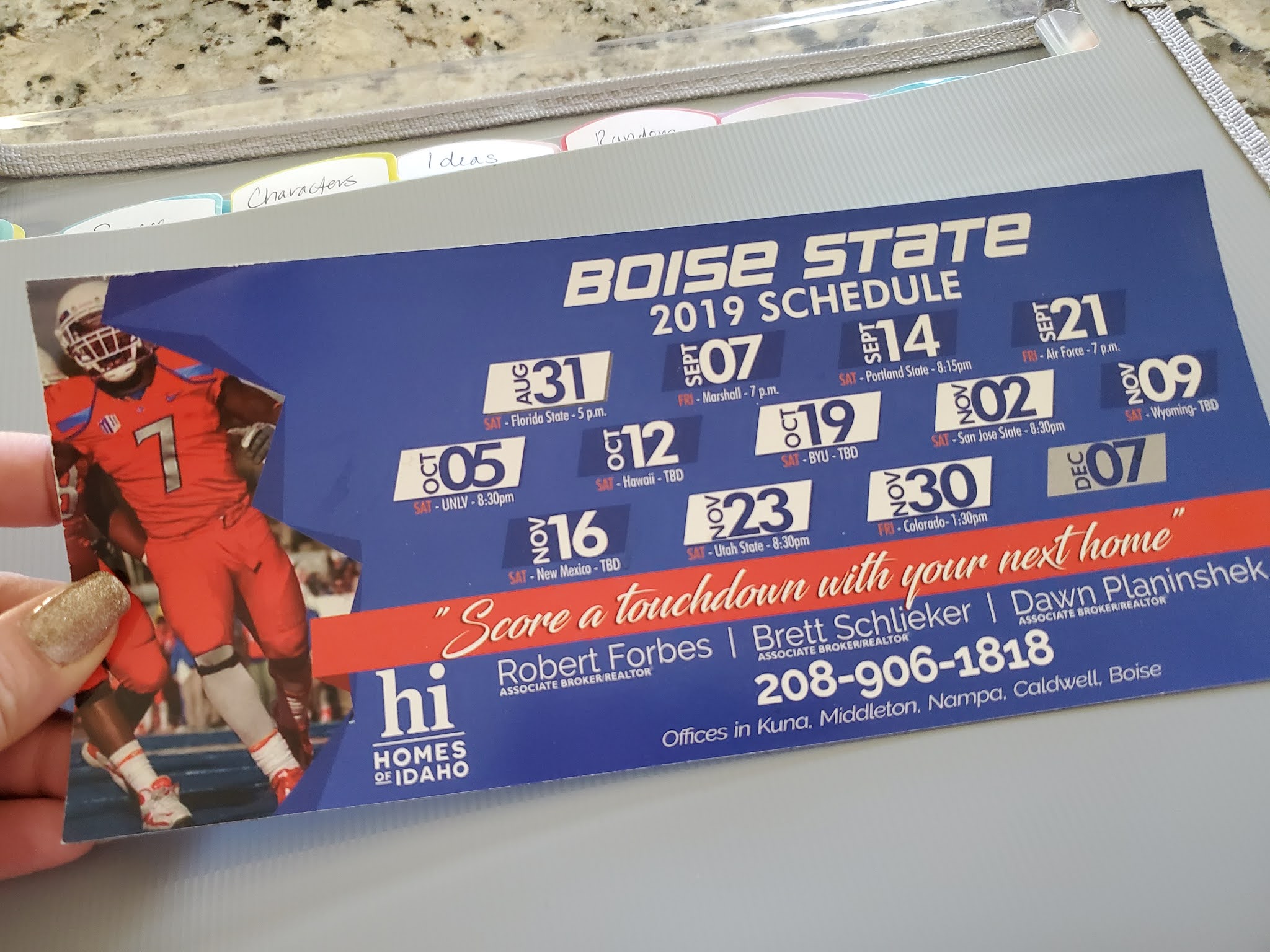
Yesterday I took my pile of In-Development cards to a brainstorming session with one of my favorite comedy writers, Heather Woodhaven. Granted, my book titled Football is My Boyfriend is based on the football season, so I was also able to pull this old season calendar out of my folder.


This feels kind of like cheating, but it was great for knowing where a scene should go even if I didn’t have an idea for it yet. I was able to say, “This is an away game, so they are probably watching at Payton’s mom’s house, but I don’t know what happens there.” Then we’d look at the scene before and after, see exactly where the characters were at in their motivations, and fill in the blanks accordingly.


Coming Soon from Kregel Publications!


It was great because I was able to tie all my random ideas together. Some ideas were vetoed by Heather like “her dog dies.” I really didn’t want to kill the dog, but I needed my characters to have motivation for an upcoming scene. We were able to take other random notes that I didn’t remember writing like “her uncle shows up” to fill in that blank and trigger specific reactions in each of my characters.

My favorite moment came from a connection we made with a sledgehammer. “Yes!” I yelled and scribbled “sledgehammer” across the card. Heather added, “It was meant to be!” Which I followed up with, “It’s brilliant!” Then the wind whipped the card away into a nearby fountain we couldn’t reach, and we both stared at it for a moment. “It’s good luck,” Heather finally said. “Like throwing a penny into a wishing well.”

I liked that perspective. But rather than wish for a story that works, I’m going to keep filling out these cards.

Scene #1

Alpha Point: Angela fills out plotting cards for the first time.

Subplot: Heather enjoys the process and gets excited to finish her last contracted Love Inspired Suspense novel so she can start her own romantic comedy.


Cause: Angela is trying to figure out life after cancer.

Effect: Angela gets invited to blog about her new process by Erica Vetsch.


Why it Matters: Angela cares about story and wants to be an inspiration to other writers.

Realization: Getting organized is worth the extra time and effort.


And so…Whether or not she writes a bestseller, wins awards, or has Football is My Boyfriend made into a movie with Emma Stone and Ryan Gosling, she will still find more satisfaction in her work.


Links:
https://www.bookbub.com/authors/angela-ruth-strong


Angela Ruth Strong sold her first Christian romance novel in 2009 then quit writing romance when her husband left her. Ten years later, God has shown her the true meaning of love, and there's nothing else she'd rather write about. Her books have since earned TOP PICK in Romantic Times, been optioned for film, won the Cascade Award, and been Amazon bestsellers. She also writes non-fiction for SpiritLed Woman. To help aspiring authors, she started IDAhope Writers where she lives in Idaho, and she teaches as an expert online at WRITE THAT BOOK.

Erica Here again: Describe your writing process. Plotter/Pantser, scene cards, outlines, snowflake method, darts at the wall? We want to know! 


Monday, September 14, 2020

Story Planning Software: Plottr

  Missy Tippens


Do you like to visually plan your stories--mind maps, poster boards, sticky notes, charts, Scrivener cork board, notecards, and/or timelines? If so, I’ve discovered a great new app I wanted to share with you today!


Plottr. It helps you create visual timelines that can assist you in generating your outline/synopsis.


I bought the program back in May and feel as if I’ve barely put a dent in all I’ll be able to do with it. Plus, as they get feedback from authors, they’re releasing new features constantly. I’ll just share a few of the features I’ve been using and really like.


One of my favorite things is being able to use a template. I have a hard time seeing the big picture in a story, so this really helps me keep on target. They offer many templates, some of which you’ve already heard of or used. Just a few examples are The Hero’s Journey (Joseph Campbell), Romancing the Beat (Gwen Hayes), 12 Chapter Mystery, The W Plot, and Story Circle (Dan Harmon). I played around with two or three and finally settled on using Romancing the Beat. I love it!


What’s great is that you can fill in each beat as is, or you can move things around to suit your story. Everything can be dragged and dropped. You can have multiple plot lines. You can have multiple views (vertical or horizontal). You can use multiple colors. You can pull up your story in outline mode or timeline mode.


Here’s an example so you can envision how the timeline works.


You can create plot cards and also store info about your characters. You can even keep track of a series! You can create a story bible. You can store photos/images. Here's an example of storing information about Places:


You can tag things, so that if you want to do a search—for example one particular character—you can pull up everything with that tag and follow that character’s scenes. You can also tag particular plot lines (romance, character arc, faith journey, etc) so that you can keep up.


Here’s an example of tagging and filtering:


Once you have your timeline filled in, you can auto-generate an outline.


I just discovered you can even add dialogue snippets if they hit you while you’re working. :) I’ll be using that soon.


I also thought it might help to see the timeline in vertical view in case your brain works better seeing it that way:


I could go on and on. Here's a link to Plottr so you can check it out. (No affiliate links. I just wanted to include a link to make it easier for you.) You can download a free trial to see what you think of it. They also have demos you can check out.


Plottr was created by Cameron Sutter. Cameron was a software engineer by trade who was writing novels but having trouble figuring out how to plan them and be able to keep track of notes, and manage story elements that changed all the time. A friend in his writing group suggested a visual tool for planning stories. So he got to work on one using his software background!


I’ve used the Scrivener corkboard for planning my stories (it’s the only feature I use in Scrivener). But I find Plottr works much better for me. I can do a lot more with my plot (scene/beat) cards. I’m pleased that I can get a visual grip on my whole story. And for those who do use Scrivener, you can export to Scrivener. You can also export to Word. Another feature in the works now at Plottr…you’ll eventually be able to sync with Scrivener. 


I’ll be here today to answer questions. As I said, I’ve only scratched the surface. One nice thing is that there’s a Facebook page for users to ask questions (or just lurk like I do). :)


If you like to plan your stories visually, I hope you'll check it out. Let me know what you think!


After more than 10 years of pursuing her dream of publication, Missy Tippens, a pastor’s wife and mom of three from near Atlanta, Georgia, made her first sale to Harlequin Love Inspired in 2007. Her books have since been nominated for the Booksellers Best, Holt Medallion, American Christian Fiction Writers Carol Award, Gayle Wilson Award of Excellence, Maggie Award, Beacon Contest, RT Reviewer’s Choice Award, and the Romance Writers of America RITA® Award. Visit Missy at www.missytippens.com, https://twitter.com/MissyTippens and http://www.facebook.com/missy.tippens.readers.

Wednesday, August 5, 2020

Plotting for Pantsers


by Mindy Obenhaus

Plotting. Some writers are meticulous about it, while others get heart palpitations at the mere thought. I’m a pantser at heart, however I’ve learned that I’m more productive if I have a good chunk of the story plotted prior to writing my proposal.

Most pantsers think of plotting as rigid and constraining. So the first thing we need to do is change our perception of plotting. Instead of approaching it as a hard-and-fast outline that you cannot deviate from, what if it’s simply a guideline to help keep us on task? That was key to turning this pantser into a plantser.

What does plantsing look like?

You have your story idea with your main characters. Perhaps you know how the story is going to end or you have a few scene ideas. Great! Write those down. I’m a visual person, so I use a very simplistic Word .doc with a chart that is broken down into the number of chapters with two boxes (scenes) per chapter. If I have an idea for the ending, I fill that in. I also add any other scenes I have in mind wherever I think they might occur in the story. Since it’s on the computer, whatever I write is easily moved to another chapter/scene later on.

With those things out of my head and on the page, I ask myself where the story begins. Every story starts with an inciting incident. That event that upends life as your h/h knows it and sets them on their journey. Like when a single mother runs into the father of her child. A child he knows nothing about. Or when a woman offers to help her neighbor who’s been thrust into the role of guardian for his five-year-old niece.

Great, we have an opening. Now what?
What’s at stake?

When the story opens, even before the inciting incident, your character has a goal (what they want), a motivation (why they want it) and a conflict (what keeps them from their goal). But what will happen if they don’t achieve their goal? That’s what’s at stake. Example: My heroine who learns her rancher neighbor is now guardian of his niece owns the local hardware store. Her goal is to expand her store before a regional building supply company moves into the area so she can establish her store as the go-to place for home improvement supplies (motivation). But her store is landlocked, so the only way to increase the footprint of her business is to purchase the building next door, but the owner has no interest in selling (conflict).  Her business is what’s at stake. If she can’t expand her store, she’ll lose business to the big box store.

Stakes are important and sometimes overlooked in the pantsing process. But if the stakes aren’t clear, an editor will likely pass on your story. I speak from experience. 😉

What happens next?

That single question is key to my plotting process. From one scene to the next I ask myself, “What happens next?” Then I write down whatever comes to mind. Sometimes it’s dialog, other times it’s just a matter-of-fact statement to prompt me later. However, there are those times when I have no idea what comes next. And the best way I’ve found to overcome that is with another question.
What’s the worst thing?

In his book Writing the Breakout Novel, Donald Maass says to think of the worst thing that could happen to your character in that particular moment and then find a way to make it happen. I blew that question off for years. Until I realized that it really works. It creates automatic conflict and ups the stakes. The downside is that it’s not always easy. Sometimes the worst thing takes us down a road we don’t want to travel. Been there, done that. I’ve ignored those nudges God kept giving me. It resulted in multiple rewrites. When I finally relented and gave in to God’s prompting, my editor loved the story.

Working backwards.

If going forward becomes a struggle, try working backwards. If you know how the story is going to end, work backwards from that point. Ask yourself what happened leading up to the ending.

By taking the time to think through my story, I’m able to fill in most of the blanks on my chart with at least some basic information (like scene goals, motivation and conflict and what’s at stake). Then that aids me in writing the synopsis and allows me to write the story faster because I know what’s going to happen.

Of course, the pantser in me cannot be ignored, so I usually write my first three chapters before I start plotting. And, when working on my chart, I always allow myself the freedom to write whatever comes to mind. Sometimes I’ll write entire scenes or big chunks of dialog. Then all I have to do is cut and paste. And yes, sometimes things change as I’m writing and that’s okay. Because plantsers don’t like rigid.

Are you a pantser who would like to be more productive? Consider trying something different. Even one thing that makes you more productive is worth a shot. Plotters, do you have any tips for pantsers that will still allow them the freedom they love so much?

I’m giving away another copy of my July release, A Father’s Promise, to one lucky commenter (U.S. mailing addresses only, please).

Is he ready for fatherhood?
He doesn’t think he deserves a family… But now he has a daughter.
Stunned to discover he has a child, Wes Bishop isn’t sure he’s father material. But his adorable daughter needs him, and he can’t help feeling drawn to her mother, Laurel Donovan—a woman he’s finally getting to know. But can this sudden dad overcome a past tragedy that has him convinced he’s not meant to be a husband or a father…and make a promise of forever?


Award-winning author Mindy Obenhaus is passionate about touching readers with Biblical truths in an entertaining, and sometimes adventurous, manner. She lives on a ranch in Texas with her husband, two sassy pups, countless cattle, deer and the occasional coyote, mountain lion or snake. When she's not writing, she enjoys spending time with her grandchildren, cooking and watching copious amounts of the Hallmark Channel. Learn more at www.MindyObenhaus.com