Showing posts with label Craft. Show all posts

Thursday, June 1, 2023

The Power of Setting


When most readers pick up our novels, they’re anticipating an escape. They want to find a few moments away from their everyday lives to live in a world with their favorite (or soon to be) characters. While characters and plot are undoubtedly essential components, never overlook the vital role that setting plays. As authors. we must craft the setting of our stories to evoke emotions and enrich the plot. We need to create an experience for our readers that makes them look forward to our next book or continue reading our series, because we given them a book that’s the entire HEA experience.


Setting as a Character

Just as we carefully craft our characters with backstory, hopes, and dreams, the setting of a novel often assumes the role of a character, as well and should be treated with the same diligence. A well-developed setting possesses its own personality, history, and distinct characteristics that influence the story and its inhabitants. Let’s bring in the masters as examples: J.R.R. Tolkien's Middle-earth or Arthur Conan Doyle's fog-shrouded Victorian London. These settings aren’t just backdrops, but “story engines” that shape the events and drive the actions of the characters. By infusing the setting with depth and personality, we can draw our readers into our fantasy world, allowing them to feel as though they are truly part of the world within the pages.

Setting as a Source of Conflict

Setting can be a fertile source of conflict, intensifying the challenges faced by the characters. Whether it's a bleak and desolate post-apocalyptic wasteland, a medieval castle fraught with hidden dangers, or a small mountain town with it’s own everyday drama, the environment can present formidable obstacles that characters must overcome. Depending on the plot of your novel, the setting can also reflect societal, cultural, or political tensions, adding layers of complexity to the narrative. Imagine a tinder dry California town threatened by wildfire, or a 9.0 earthquake that shakes a major city that then needs to brace for the ensuing tsunami. By integrating conflict within the setting, we not only heighten the stakes but also invite a deeper connection between our reader and the story's events.


Setting as an Emotional Catalyst 

The power of setting lies in its ability to evoke emotions and immerse readers in a particular atmosphere. From the cozy charm of a small-town cafĂ© to the foreboding gloom of a haunted mansion, the ambiance created by the setting can elicit a wide range of emotions. Can we all say Agatha Christie, Stephen King, Ray Bradbury? A well-described setting can transport readers to another time, place, or state of mind, enabling them to experience joy, fear, nostalgia, or awe alongside the characters. By building on powerful sensory details of the setting, we can foster an emotional connection that our readers won’t soon forget.

Setting as a Reflection of Themes

A thoughtfully crafted setting can serve as a symbolic representation of the novel's themes and motifs. The physical environment can mirror the internal struggles or conflicts faced by the characters, offering a glimpse into how our character perceives themselves and their situation. Think about it — a decaying, dilapidated cityscape may symbolize societal decay or the loss of hope, while a lush, vibrant forest might represent growth, renewal, or freedom. By posturing the setting with the story's underlying themes, we can create a deeper layer of meaning, even if our protagonist is fighting for the future of her bakery or to wrangle back possession of his ranch.


Storytelling is an art form and the importance of setting can’t be overstated. A well-crafted setting breathes life into a novel, immersing readers in a world that exists beyond the confines of their imagination. It acts as a character, a source of conflict, an emotional catalyst, and encourages the reader to see beyond the simple stated text. By recognizing and appreciating the impact of setting, both authors and readers can embark on thought-provoking journeys that resonate on a profound and unforgettable level. 

So, next time you sit down to work on your novel, or open a novel as a treat for reaching a goal, pay attention to the setting—think about the story going from “That was a good read” to “Wow! When is the next book coming out!”

*  *  *

Audra Harders writes "rugged stories with heart" featuring fearless men who haven't a clue about relationships, rescued by ladies who think they have all the answers. In real life, she's married to her own patient hero, has two adult children, and a very strong-willed Corgi. She began writing right after her second kidlet was born and sold her first book to Love Inspired mere months before that same young adult graduated from high school. Surviving those years in between reminds her God does have a plan for her life...and that He has a tremendous sense of humor. You can visit Audra at:

Website: www.audraharders.com

We know that in everything God works for good with those who love Him, who are called according to His purpose. ~Romans 8:28 RSV

Wednesday, March 1, 2023

Falling in Love with Your Next Book


 by Mindy Obenhaus

So here I am at the beginning of a new story. And I'm realizing the process is a lot like dating. C'mon, let me show you what I mean.

The Initial Meeting -

Your eyes meet, and you both feel it. That spark. You strike up a conversation, and your heart is all aflutter. Could this be the one? 

Yes, each and every book starts with a spark of an idea. It could be a premise or a character. Whatever the case, you're intrigued. And the possibilities seem endless. But before you can commit to writing the story, you need more information.

Getting to Know You -

You meet for coffee, go on a few dates, text/talk often. Learning a little bit more about one other with each conversation.

As with any good relationship, you have to get to know one another. Perhaps there's an element to your story that you don't know much about. Do your research to find out if it will work for what you have in mind. 

You also need to get to know your characters. What do they do for a living? Where are they from? What is their family like? Do they have siblings? What are their likes and dislikes? What do they want out of life (aka, goal), why (motivation) and what stands in their way (conflict)? 

Taking Things to the Next Level -

Things are clicking. But before you commit to a relationship, you want to know more about them. Their hopes and dreams. Do they want kids? 

It takes time to dig deeper and find out what makes your characters tick. The more you know, the more layered your characters become. And those layers not only enrich a story, they can often drive it. What is their greatest dream? Their greatest fear? And don't forget to channel your inner four-year-old by perpetually asking "Why?"

Make or Break?

So, the relationship seems to be clicking. But are you just comfortable with each other or do you see it becoming a committed relationship?

If a story isn't working or seems to fall flat, then it might be time to move on. Go back to the drawing board. Though things might not be a total wash. In this story I'm working on, I had the right characters, but I was trying to fit them into a story that was all wrong for them. There was no conflict. So, I came up with a completely different plot where the conflict was organic and not forced. And now the sparks are really flying. 

New story love can be exhilarating. We're infatuated with the characters and the story. But infatuation doesn't necessarily lead to a happily ever after. Get to know both your story and your characters before taking the plunge so you have all the elements to carry you on to that happily ever after.

I'm giving away a copy of Easter on the Ranch, a 2-in-1 with the first book in my Rocky Mountain Heroes series, Their Ranch Reunion, and Jessica Keller's The Rancher's Legacy. Simply leave a comment to be entered. (US mailing addresses, please)


Spring and second chances

The Rancher's Legacy by Jessica Keller

Returning home isn’t part of Rhett Jarrett’s plan—until he inherits the family ranch from his father. Running it won’t be easy with his ranch assistant and childhood friend, Macy Howell, challenging all his decisions. But a long-buried family secret might help Rhett begin to see things Macy’s way…and allow them to find love—and a home—together at last.

Their Ranch Reunion by Mindy Obenhaus

Single mom Carly Wagner is surprised to learn she’ll have to share ownership of the home she’s inherited with her first love, Andrew Stephens. Now a successful businessman, he’s standing in the way of her dreams to expand her B and B. Andrew has eight weeks to buy Carly out. But Carly’s too stubborn to persuade—and too beautiful to ignore. Should he leave and chase another deal…or stay and chase Carly’s heart?


Award-winning author Mindy Obenhaus is passionate about touching readers with Biblical truths in an entertaining, and sometimes adventurous, manner. She lives on a ranch in Texas with her husband, two sassy pups, countless cattle, deer and the occasional coyote, mountain lion or snake. When she's not writing, she enjoys spending time with her grandchildren, cooking and watching copious amounts of the Hallmark Channel. Learn more at www.MindyObenhaus.com  

Friday, March 25, 2022

If the Shoe Fits

In Cinderella, the glass slipper only fit Cinderella’s foot. As the story goes, of all the girls in all the castles in all the kingdom, the shoe fit her foot and hers alone. No matter how hard they tried, the other girls couldn’t wear the glass slipper.

Oliver Herford, Public Domain

Your synopsis is the shoe, your story is the foot. Stick with me now…

So, you’re working on your first (or next) Great American Novel. You’ve written the first few chapters, and you’re dipping your toes into contests and even getting brave and submitting to agents and editors. Or, you might even be selling on proposal, a short synopsis and a chapter or two.

If you’re at this stage of the writing game, then you’ve written the dreaded synopsis. There are great articles here in Seekerville and all over the ‘net to help you determine what goes into a synopsis and what doesn’t, so I’m not going to rehash that today.


But what I am going to address is whether your synopsis reflects the story you’re writing. Sometimes we writers—intentionally or maybe unintentionally— sensationalize our synopsis to the point that it doesn't even resemble the actual chapters, similar to the practice of padding a resume.

How many times have I dumped every conceivable plot device into my synopsis because a critique partner or contest judge suggested it, and I thought it would be cool? I wonder how many times I gave the "snake oil" sales pitch in the synopsis, but the story didn't live up to the synopsis and that's why contest judges and editors said no?

Some examples to make my point…

If I write a synopsis that sounds like a very dark 90K romance that deals with drunk driving, a family feud, long-lost love, and two main characters dealing with all this traumatic back story, but if my opening chapters feel and sound like a 20K novella, there’s a disconnect somewhere.

Or, how about this…

If my synopsis describes the lives of Bonnie and Clyde, but my chapters are the light-hearted, knee-slapping antics of Lucy and Desi, I’ve got a problem.

The best example I can give of my own writing would be my debut novel, Stealing Jake. Stealing Jake started out as a light, sweet novella and went through several rewrites that kept upping the tension.

If I had sent the lighter novella version of the story in with a synopsis detailing shipping street kids across the country in crates, sweat shops, a coal mine explosion, the traumatic incidents from both the hero and the heroine’s pasts, it just wouldn't have really worked together. And I’m afraid it would have tanked in contests, as well as been rejected by industry professionals.

It’s important to make sure a contest judge, critique partner, agent or editor gets the same jolt from the chapters as they do from the synopsis. Either the tension in the chapters need to be ratcheted up, or the tension in the synopsis ratcheted down. And, you, as the author, are the only one who knows which direction you need to turn the ratchet.


So, how do you do that?

Is your manuscript in the early stages or is it completed? If it’s completed, then you’re ahead of the game. Write your synopsis to fit the story and you're good. If you’ve just started this story, determine the genre and the tone. Do you write light-hearted contemporary romance, or dark historicals, or women’s fiction with snarky leads?

Read books that are similar to what you write, then describe them in your own words, just like giving a book report. See if you can hit the tone of these books. And, as an additional exercise, maybe look at some good professional reviews of those books. Do some of them describe whether the book was light, or dark? Do you agree with the assessment?

If you have a critique partner, let them read both. If they’ve worked with you a long time, they might be able to tell you if the two pieces are simpatico.

And, lastly, trust yourself. If you got it wrong, it’s not the end of the world. Just keep tinkering with it. Eventually, you’ll get it. Over the years, I've submitted multiple proposals for historical romance novellas to Barbour Publishing. The proposals were extremely short, but I’ve been writing historical romance for a long time, and I’ve written a lot of proposals for novellas, and read my fair share. 

I knew enough about the process to keep the synopsis sharp, clean, and free of secondary plots. I sold FOUR proposals to Barbour in one year because I nailed the synopsis. As expected, the novellas have a lighter tone than my full-length novels, and the one (Shanghaied by the Bride) even had a bit more of a humorous tone than is my norm, something that was clearly spelled out in the synopsis and was also clear in the title, which Barbour kept.

Bottom line, know the story you want to tell well enough to make the synopsis fit.

Otherwise, that shoe's really gonna pinch.


Pam Hillman was born and raised on a dairy farm in
Mississippi and spent her teenage years perched on the seat of a tractor raking hay. In those days, her daddy couldn’t afford two cab tractors with air conditioning and a radio, so Pam drove the Allis Chalmers 110. Even when her daddy asked her if she wanted to bale hay, she told him she didn’t mind raking. Raking hay doesn’t take much thought so Pam spent her time working on her tan and making up stories in her head. www.pamhillman.com

Friday, March 18, 2022

Writing the Book Blurb - Part 2


Hello everyone, Winnie Griggs here. Back in January I posted about writing book blurbs (you can read that post HERE) and promised you a Part 2. So today I'm delivering on that promise.

First a caveat - this is just my thoughts on what makes up a good blurb. There are likely other methods that are as effective if not more so.


First let’s talk about what goes into a blurb.
I consider that these the four components are the minimum of what you need.to create an effective blurb. 

  • The Tag Line
  • The Characters:
  • The Conflict:
  • The Close:


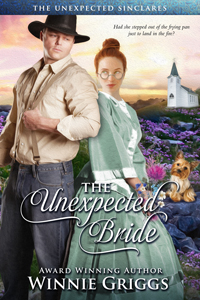
For the purposes of this series of posts, I’m going to use the blurb from the first book I had to craft a blurb for all on my own. We’ll look at what I did right, what I did wrong, and what I might do differently today. It’s for my book The Unexpected Bride, an April 2019 release. It reads as follows: 


Fleeing an arranged marriage, socialite Elthia Sinclare accepts a governess position halfway across the country. But when she arrives in Texas she finds more than she bargained for - more children, more work and more demands. Because Caleb Tanner wants a bride, not a governess. But marrying this unrefined stranger is better than what awaits her back home, so Elthia strikes a deal for a temporary marriage. She says I do and goes to work—botching the housework, butting heads with her new spouse, loving the children.

Caleb isn’t sure what to make of this woman who isn’t at all what he contracted for—she’s spoiled, unskilled and lavishes her affection on a lap dog that seems to be little more than a useless ball of fluff.  But to his surprise she gets along well with the children, works hard to acquire domestic skills and is able to hold her own with the town matriarchs.

Could the mistake that landed him with this unexpected bride be the best thing that ever happened to him?


So today I want to dig into the first component.

The Tagline.

Technically, the tagline is optional, but I think having one adds a little extra punch to your blurb. The Tagline, also called a log line, is a very short teaser, designed to hook the reader and introduce the tone of the book. There are several different ways to approach this.


  1. You can do the A meets B format. Here’s an example
    Jane Austen meets Sherlock Holmes in this new Regency mystery series
    (from Erica Vetsch’s Jan 2022 release The Debutante’s Code)

    Another version of this format is to simply reference to the genre/tropes you’re mashing together – i.e. A regency era female turns detective in this new mystery series. (My apology to Erica if I didn’t properly capture the tone of her book)

  2. You can pose a question, as in this one
    As her plans unravel, can she give her children what they truly need?
    (from Mindy Obenhaus’s Nov 2021 release Their Yuletide Healing)

  3. Then there’s the contrast method.
  4. She mixed danger, desperation, and deception together. Love was not the expected outcome.
    (from Mary Connealy’s March 2022 release The Element of Love)

  5.  And lastly, you can simply showcase the heart of the story as was done in the blurb for my upcoming May 2022 release Her Amish Springtime Miracle.
    In this delightful and heartwarming novel, an orphaned baby brings together an unlikely couple who learn the true meaning of family.


Unfortunately, I didn’t include a tagline for The Unexpected Bride (shame on me!). So if I were to try to craft one today, how would I go about it? Well, let’s see how it might look using each of the four methods above.

Using method one:  A runaway heiress must serve as housekeeper and nanny in this accidental Mail Order Bride story

Using the second method:   Can a klutzy socialite who ends up far from home provide the care and love six orphaned children and their determined uncle so desperately need?

Using the third method:   She ran away from home to escape an unwanted engagement. So how did she end up agreeing to marry a disagreeable stranger?

And using the last method:   In this heartwarming story, an inept runaway socialite must build a loving home for six orphaned children and their much too serious uncle.

So which one would I actually use? The test would be which one I thought provides the best hook while remaining true to the story.  Right now I'm thinking it would be the third one.

A couple of tips:

  • Just because the tagline appears at the top of your blurb doesn’t mean it needs to be created first. If you’re having problems figuring it out, craft the rest of your blurb first and then come back to it. Hopefully the key tone and story essence you want to convey will pop out to you then
  • To figure out what part of your book would make the best hook, ask yourself what is most unique or interesting about your story. 


There you have it, my notes on how to craft your book blurb’s tagline. Next time we'll look at the second component, the characters.

So do you have any questions? Do you agree with this approach? Would you have chosen (or crafted) a different tagline for TUB than the one I chose? 

Leave a comment to be entered into a drawing for a book from my backlist

And if you're interested in learning more about The Unexpected Bride or ordering a copy, click HERE


Wednesday, April 7, 2021

Engaging Openings


by Mindy Obenhaus

Recently, a fellow author and I were discussing opening scenes, why some really grabbed hold of the reader’s attention while others lacked punch, despite having key elements such as the h/h meeting quickly, goal, motivation and conflict, etc.

An opening scene needs to be engaging and make the reader care about the character enough to embark on their journey with them and see it through to the end. But that doesn’t mean that all openings are cast from the same mold, does it? Curious, I went back and looked at the opening scenes of some of my books.

Just in my two most recent releases things varied considerably. In A Father’s Promise, book one in my Bliss, Texas series, the hero and heroine don’t even see each other until the end of the first scene. And when they do, it’s barely a glimpse and they don’t speak to each other. While in book two, A Brother’s Promise, the h/h are conversing by the bottom of page one.

I write for Love Inspired Books and one of their must-haves is that the hero and heroine meet in the first scene. However, whether they lay eyes on each other on page one or page fifteen or somewhere in between depends on the story. Wherever it happens, though, readers need to be engaged from the get-go. If they’re not, they’ll put the book down and we don’t want that.

So how does one craft an opening that will make readers want to keep reading?

Goal, motivation and conflict – You’ve heard this over and over again. Every character has to have a GMC not only for the story, but for each and every scene. In chapter one, though, it’s their story goal, motivation and conflict that needs to be established so the reader knows what the character wants, why they want it and what stands in their way. It’s what makes us want to cheer them on. Now, that’s not to say that their GMC might not change at some point during their story, but in the opening scene, it’s what starts them on their journey and invites the reader to join them. And it needs to presented ASAP.

Stakes – What’s at stake goes hand-in-hand with GMC. Stakes are what will (or could) happen if they don’t achieve their goal. In A Father’s Promise the heroine wants to name a guardian for her infant daughter so that if the heroine (who has no family) were to die, her daughter would be taken care of by someone who loved her. The stakes are that if she doesn’t name a guardian and something does happen to her, the daughter would become a ward of the state. Stakes are the driving force behind each goal.

Inciting incident – Once we know our character’s goal, motivation and conflict and what’s at stake, it’s time to contemplate the inciting incident. This is when something about the hero and heroine coming together changes the trajectory of their goal and/or life. Needless to say, when my heroine in A Father’s Promise sees her baby’s father, she knows her life is about to change in some way. In A Brother’s Promise, it’s when Christa learns that Mick is now the guardian of his five-year-old niece and she can’t help but reach out to them in hopes of making the transition easier for little Sadie. The inciting incident is what brings the hero and heroine together and often results in a common goal. But we can’t simply bring them together. No, we want to…

Rock their world – Example, my very first book was a secret baby story. Of course, the heroine knew her life was about to change as soon as she saw the hero she believed turned his back on her and her son nine years prior. However, the hero didn’t learn about the boy until chapter three. Then an editor asked me to revise it, stating that she wanted him to find out sooner. So I reworked things, bumped it up a little, though not by much and said editor bought the book. Imagine my surprise when I received my edits where she stated she wanted the hero to learn about the boy at the end of the first chapter. At the time, I wasn’t too thrilled about that, but I soon saw how right she was. Instead of simply seeing the girl he loved and whose heart he’d broken, his world was rocked by the knowledge that he had a son!

In my August 2021 release, the hero and heroine both want to purchase an abandoned castle. The owner refuses to sell but issues a counteroffer. The h/h—who can’t get through a church committee meeting without butting heads—must work together in exchange for exclusive rights to use the castle as an event center and a museum.

When trying to come up with a rock-their-world moment, it helps to use an approach you all have heard me mention before. Ask yourself what’s the worst thing that could happen to that character at that moment and then find a way to make it happen. It can be a challenge, but it works.

When crafting the opening of your book, remember you only get one chance to make a first impression. If you don’t grab an editor’s/reader’s attention within the first few pages, they may not keep reading and that’s never good. Instead, we want to capture their attention with an opening that makes them want to journey with the characters all the way through to that satisfying ending.

Writers, what strategies do you employ for an opening with impact? Readers, what sorts of story openings capture your attention?  Leave a comment to be entered to win one of two copies of an anthology due out later this month. My April 2019 release, Her Colorado Cowboy, has been paired with Lois Richer’s, Rocky Mountain Daddy, and will hit store shelves April 16th. (US mailing addresses only, please)


Award-winning author Mindy Obenhaus is passionate about touching readers with Biblical truths in an entertaining, and sometimes adventurous, manner. She lives on a ranch in Texas with her husband, two sassy pups, countless cattle, deer and the occasional coyote, mountain lion or snake. When she's not writing, she enjoys spending time with her grandchildren, cooking and watching copious amounts of the Hallmark Channel. Learn more at www.MindyObenhaus.com


Friday, July 24, 2020

What You Don't Know CAN Hurt You

by Pam Hillman

There’s an old proverb that goes something like this, “What you don’t know can’t hurt you.”

Basically, the idea is if you don’t know about a problem or a misdeed, you won’t be able to make yourself unhappy by worrying about it. 

Hmmm, okay. 

But I suppose there is some merit to the saying, because up until three years ago, my husband and I didn’t have a television in our home. We pretty much missed all the insanity going on in the world for the last thirty years. Not that we weren’t aware and plugged in, but we just didn’t hear the news 24/7 like we do now. Now, we get a play-by-play of everything that’s going wrong in our world. I think I liked not knowing so much!

And, in the writing world, how can not knowing really be detrimental to a career? There are so many ways…

1) If you don’t know how to plot a compelling story, or how to build up tension or layer in details, keep writing, and keep learning the craft. But, first, just keep writing. You don’t get to the next step if you don’t write.

2) If you don’t know that Editor Erin loves stories featuring a love triangle, but Agent Angela isn’t fond of them at all, it might be a good idea to study up on their likes and dislikes.

3) If you don’t know the latest way the wind is blowing regarding ebooks vs. print books, why not?

4) If you don’t know if you’re writing Christian fiction or general fiction, keep writing until you do.

5) If you don’t know your story’s genre, then keep writing until you do. It doesn’t matter if you’re planning to self-publish or go the traditional route, your novel will eventually fit into some sub genre, and you’ll need to verbalize that.

6) If you don’t know about contracts/agreements and the traps to look for, it can certainly come back to haunt you. This applies to traditional publishing as well as self-publishing.

7) If you don’t know that a publishing house has closed its doors or discontinued a line, you’re really spinning your wheels by writing to the line. You’d be better off writing to your heart.

8) If you don’t know how to take your novel from your computer file to the reader (if you plan to self-publish), there’s a lot to learn. But you can do it. You have the tools at your disposal. Just keep writing.

9) If you don’t know about Seekerville, then you’re missing out on a ton of great teaching and blog posts that can answer all of the unknowns I’ve covered above and more.

10) If you don’t know about American Christian Fiction Writers (ACFW), then there’s even more knowledge to be gained within its ranks.

11) If you don’t know that you and only you can write the story that’s burning on your heart, then I’m here to tell you that you can. Start with #1. Write your story. Make it compelling. Write a story that you know backwards and forwards. And along the way, all the other points will come into play.


CBA Bestselling author PAM HILLMAN was born and raised on a dairy farm in Mississippi and spent her teenage years perched on the seat of a tractor raking hay. In those days, her daddy couldn't afford two cab tractors with air conditioning and a radio, so Pam drove an Allis Chalmers 110. Even when her daddy asked her if she wanted to bale hay, she told him she didn't mind raking. Raking hay doesn't take much thought so Pam spent her time working on her tan and making up stories in her head. Now, that's the kind of life every girl should dream of. www.pamhillman.com


Friday, July 17, 2020

Making A Scene

Hello everyone, Winnie Griggs here. As part of our Back To Basics series, I’m reprising a post I did here on Seekerville over 10 years ago as a guest - the importance and construction of story scenes

.

The workhorse of a story is not words, or sentences or even paragraphs – rather it’s the scene. It’s in a scene that we see the key element of any good story - namely relevant change.
It is the elements of both relevance and change that makes a scene a scene.

So with that in mind I’d like to discuss eight elements I believe comprise the checklist for an effective scene:


For purposes of this discussion, let’s imagine we’re working on a scene where our heroine, Deanna Deeva, is recently divorced. She’s struggling with what impact the label of divorcĂ©e will have on her social standing. She’s been invited to a party hosted by a longtime acquaintance and the scene opens when Deanna arrives and parks her car.

1. In an effective scene - something happens
The ‘something’ doesn’t have to be remarkable - it can be as simple as a single activity or as complex as several dozen story beats rolled together.

For instance, in our scene with Deanna Deeva, if the scene revolves around her fear of going out in public again, the ‘beats’ to this scene might stop with her making the decision to leave her car and walk up to the front door. The party itself may be transitioned over entirely since in this case it was her decision to actually join the party that was important to the story and to showing some aspect of her character.

On the other hand, if the thrust of the scene is to show how she handles being out among her friends, the scene could be composed of a number of beats - arriving at the party, a few awkward conversations, perhaps an overheard catty comment, catching the eye of an intriguing-looking gentleman, and the unexpected arrival of the ‘other woman’.


2. An effective scene should have a focus or goal
In other words, our character(s) will strive to achieve something. Note, the author needs to look at this on two very different levels:
One, is to view it from the character’s perspective - what does the character hope to accomplish during the course of this scene?
The second is the reader perspective. What do you as the author want the reader to come away from this scene with?
In our scene with Deanna Deeva, the character’s goal might be to prove to herself that her social standing was not adversely affected by the divorce. The author’s goal for the reader, however, may be to deepen her understanding of some aspect of Deanna’s character, either a strength or a weakness.


3. An effective scene should elicit a reaction
A well-crafted scene will evoke emotion of some sort, both in the characters on the page and in the reader. Note, these won’t necessarily be the same emotions.
Again, in our previous scene with Deanna Deeva, depending on how the author plays it out, the reaction of our focal character could be one of mortification, determination, depression, irritation, or even victory.
On the other hand, the reaction of the reader might be one of sympathy, amusement or even annoyance. A good writer will choreograph her scene to tease the emotions she wants from both the characters and the readers.


4. An effective scene will have a story purpose
The whole crux of your scene’s reason for being is to move the story forward in some fashion. There are many different kinds of scenes - fight scenes, flashbacks, love scenes, opening scenes, turning points, climactic scenes - but no matter the type, a scene must have some effect on the focal character or overall storyline . Something necessary to the story as a whole must be contained within the scene to warrant its existence, otherwise it should be rewritten or ruthlessly cut. In order to pull its weight effectively your scene should Ideally perform at least two story functions - three or four would be better.


5. An effective scene should have structure
• As in a full-blown story, each scene must have a well-defined beginning, middle and end. It’s a mini-story of sorts - there is an inciting incident, a series of actions or beats, and then a resolution that tells us we’ve extracted everything we can from this particular scene. However, with the exception of the final scenes, the scene resolution does leave some unanswered questions, some loose ends that nudge the reader into the subsequent scenes to try to find the answers.

6. A scene should show logical, believable progression
The scenes should flow one from the other, sculpting and shaping your story in an aesthetically satisfying way that is entertaining and relevant.
Since scenes are the building blocks of your story, they must be carefully placed and arranged with every other scene in order to construct a pleasing, functional whole. Each scene builds on the one that came before and leads to the next - enhancing, changing, or redirecting your through line in some way, either subtly or forcefully - always pushing inexorably forward to the story’s resolution.

CAUTION: Logical doesn’t mean predictable, but given what the reader knows about the characters and the situation, it must be a believable next step.


7. A scene should have a mood or attitude
This is the underlying emotion in your story. Is it comedic, solemn, dark, light? Are there underlying urges or desires that drive your characters? These will play into your scene in subtle or overt ways, coloring the actions and goals, informing the responses of both the characters and the reader. Again, using our scene with Deanna Deeva at the party, even using the same action beats in the scene, they will play out very differently in a romantic comedy than they would in a romantic suspense or women’s fiction work

8. The final element an effective scene must have is the one I’ve mentioned before, the all-important element of change.
The change can be big or small, but you should be able to both identify it and see how it moves your storyline forward. This forward motion can come either through revelation or a relevant honing of character, world or plot. Deanna Deeva, or her situation, must be different at the end of the scene than she/it was at the beginning.

Again, if something doesn’t change, then no matter how lyrical and elegantly crafted, no matter how invested you as a writer are in it, the scene must be ruthlessly deleted.


One final thought - the clearest test of a scene’s effectiveness is to use what Raymond Obstfeld, in his book “Crafting Scenes”, calls the so-what factor. When you finish reading over your scene, ask yourself “so what?” Is this scene necessary? If you remove it will it actually affect the outcome of the story ? Does it fit with the scene before and the one after? Did something change? Was it significant enough for its own scene or could the key points be folded in one of the neighboring scenes? 


If you answer those questions it will become obvious whether or not you've nailed the scene. 


For a chance to win a copy of any book from my backlist, Including the new 2-in-1 re-release below, please leave a comment.


Handpicked Husband

Regina Nash must marry one of the men her grandfather has chosen for her or lose custody of her nephew. But Reggie knows marriage is not for her, so she must persuade them—and Adam Barr, her grandfather’s envoy—that she’d make a thoroughly unsuitable wife. Adam is drawn to the free-spirited photographer, but his job was to make sure Regina chose from the men he escorted to Texas—not marry her himself!

The Bride Next Door

Daisy Johnson is ready to settle in Turnabout, Texas, open a restaurant and perhaps find a husband. Of course, she’d envisioned a man who actually likes her, not someone who offers a marriage of convenience to avoid scandal. Newspaper reporter Everett Fulton may find himself suddenly married, but his dreams of leaving haven’t changed. What Daisy wants—home, family, tenderness—he can’t provide…


BOOK LINK